
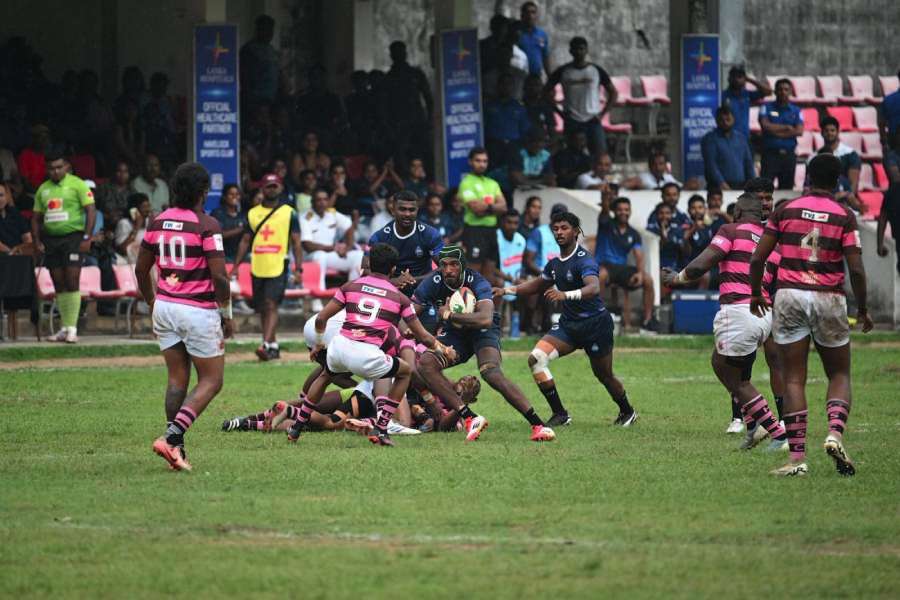
Maliban Rugby League: More brawling than surgical precision.
23 Nov 2025 | By The Touch Judge
The Maliban Inter-Club Rugby League 2025/’26
kicked off on 14 November, featuring nine teams vying for the top spot.
One of the major talking points this season is
the reintroduction of foreign players, with each team allowed to have at least
one on the field.
The league kick-off revealed both the promise
and the growing pains of its two most anticipated innovations: the return of
foreign players and the expanded use of the Television Match Official (TMO).
You want a TMO and also complain about the time taken.
The playing style reflects a brawling attitude
to rugby, less suited to the structure of local players who need to act like
surgeons with precision. Or else we will have neither crowds nor excitement,
and less hope for an Asian top spot.
Are the foreign players a skill injection or
structural distraction? The talk at rugby watering holes is about a coach
asking a Kiwi player about gym-training times. The answer was: “We train to
play rugby, much unlike the locals who have fitness in the morning, gym in the
afternoon, and on-the-field in the evening.”
Yet huff and puff to each breakdown as the game
progresses. Yet we are quick to beat the system.
In the first week, many head clashes were
penalised, and red and yellow cards were issued.
Players who get knocked have shown a tendency to
get back on their feet before medics arrive. Even faster when the match-day
doctor arrives, more often kept afloat by team staff on the field.
The reason is to dodge a Head Injury Assessment
(HIA), or recognise, remove, and avoid a mandatory off-the-field
direction.
An alarming trend: the safety and life of a
player are compromised to continue playing the next match.
After a multiyear hiatus, Sri Lanka Rugby (SLR)
reintroduced foreign players into the league, one per team at a time, with the
intention of raising the standard of play and drawing fan interest.
Except for CH & FC, the others looked very
much pedestrian, either because they have yet to blend with the play prevalent
in Lankan clubs or because they are not the top of the pops.
To ensure the best future, SLR needs a solid
advisory committee, as recognised by the Rugby Foundation in the SLR
Constitution. One committee that does not need to be headed by an Executive
Committee member.
The other three most useful committees are the
Development Committee, Technical Committee, and Match Review Committee.
Whilst the Development Committee has 12 members,
the Technical Committee has four, and the Match Review Committee has three. The
three committees must have an Executive Committee member as the
chairperson.
The three committees carry the central thrust
and require a high degree of technical expertise. The Executive Committee has
limited numbers and will need to co-opt external advice. Progress hinges on the
strength of leadership within the Executive Committee.
While many Executive Committee members may lack
the necessary technical expertise (such as a current World Rugby
accreditation), effective leadership can nonetheless steer each committee
towards success.
A compelling example is the late Gamini
Dissanayake’s tenure in cricket, where visionary leadership compensated for
technical gaps and drove the sport forward.
Playing structural concerns
Some clubs, particularly Sri Lions and Police
SC, appeared tactically unprepared to integrate their foreign players, often
isolating them or relying too heavily on their individual brilliance.
In the first week, only three clubs had foreign
players on the field. Despite the Havelock Sports Club registering a foreign
player, none were on the field.
While the foreign player rule is to add flair
and physicality, its success will largely hinge on how well clubs integrate
these players into their systems, not just for the highlight reel.
Technology meets teething issues
The expanded use of the TMO in Week 1 was a
welcome step towards transparency and accuracy, but its implementation was
uneven.
In the Navy vs. Havelocks draw, the referee
clearly led the review and decided on a red card to an Havelocks player whilst
the TMO was aligning towards a yellow card.
As stated in the World Rugby protocol, it is the
referee who leads the discussion and takes the correct decision based on the
intervention that upgraded a yellow card to red for lifting a player off the
ground, a decision that changed the game’s momentum.
Several tight try-or-not-try calls were resolved
with clarity, particularly in the CR & FC matches, where grounding and
touchline decisions were reviewed efficiently.
Inconsistent usage: some matches saw multiple
TMO interventions, while others – despite clear foul play or grounding
uncertainty – relied solely on the on-field referee.
The TMO is a step forward, but it needs a
game-related understanding by the team and better communication infrastructure;
otherwise, it risks becoming a source of confusion rather than clarity.
Already, one club has written about the time
taken for a review. Internationally, TMO reviews in rugby typically take
between 60 and 120 seconds, but complex decisions can take longer than three
minutes.
·
Standard reviews (e.g. grounding, touchline checks): 60–90 seconds
·
Foul play reviews (e.g. high tackles, dangerous clear-outs):
90–180 seconds
·
Complex or multiphase reviews: can exceed three minutes,
especially when multiple angles or incidents are involved
Factors affecting review duration
·
Number of replay angles: TMOs often require multiple views – tight
angles for context, slow motion for detail
·
Clarity of footage: poor lighting, obstructed views, or fast play
can slow down decision-making
·
Referee-TMO dialogue: the on-field referee may request specific
clarifications, which adds time
·
Protocol adherence: World Rugby’s best practices encourage a
minimum of two replays – one for context, one for detail
World Rugby emphasises accuracy over speed while
also encouraging efficiency. The ideal is a review that:
·
Provides clear context and detail
·
Minimises disruption to game flow
Globally, these times are made possible by
highly technical operators and the assistance of Hawk-Eye or similar
technology. Sri Lanka does not have the technology at present.
The TMO operator assists the TMO by operating
the independent video replay system. As part of this, they will integrate with
broadcast, referee communications, sport presentation, and the technical
providers of the video replay system.
During the match, the TMO operator must quickly
and efficiently provide the video content required by the TMO to enable them to
review the incidents in question.
In addition, they manage the production of the
formal review clip, rolling it live on air and onto the stadium big screens.
Strategic implications for coaches and officials
Coaches must now plan for the utilisation of
foreign players, not just tactically but also emotionally – how to avoid
overreliance or locker room imbalance.
Referees and TMOs need more straightforward
guidelines on when to intervene, especially regarding head contact, grounding,
and foul play – areas that shaped outcomes during the opening week.
(The views and opinions expressed in this article are those of the writer and do not necessarily reflect the official position of this publication)
•Courtesy from “www.themorning.lk”
Link-
https://www.themorning.lk/articles/ySOeANFso1vGJbAtyOgG
Related News


World Rugby News


©2018 - SRI LANKA RUGBY - All Rights Reserved
Site by www.stats.lk