
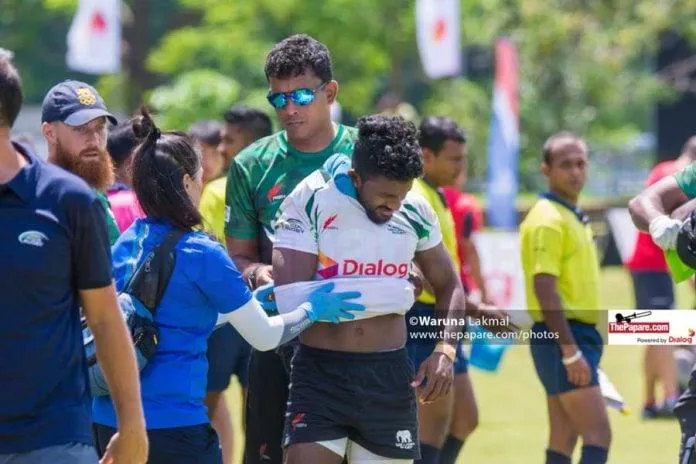
Dangerous play: SL rugby’s litmus test
· 30 Nov 2025 | By The Touch Judge
If we cannot protect our players, we cannot protect our game
·
Revival without safety is a hollow promise
Dangerous play has become one of the most pressing issues
affecting rugby worldwide and Sri Lanka is no exception.
As the domestic game seeks revival amid the rise of unsafe
tackles, reckless collisions, and poor technique, player welfare, match
integrity, and the sport’s credibility are at stake.
The revival at risk
Amid this optimism, one issue threatens to derail progress:
the rise of dangerous play.
Reckless tackles, unsafe collisions, and poor technique are
not just isolated incidents; they are becoming systemic, undermining both
player welfare and the credibility of the sport.
Who is responsible? Is it the players, the coaches, or the
administrators of the school and club system? What can the governing body do
about the situation?
Why dangerous play persists
Coaching gaps
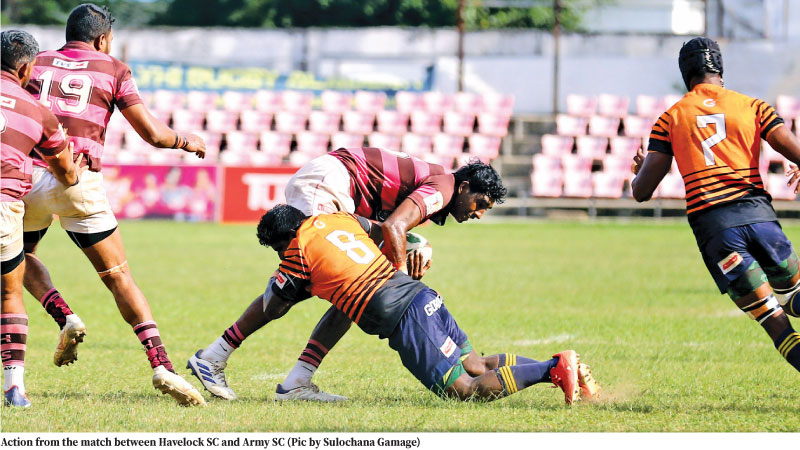
Grassroots and club-level training often neglect tackle
safety, leaving players ill-prepared. Seen at recent matches is an
improvisation of the tackle where the hands seem to be around, not to complete
the tackle, but to show you are doing so while actually executing a chop below
the knee.
Cultural glorification
‘Big hits’ are celebrated, while controlled, legal tackles
rarely receive recognition – cultural factors: the ‘hard rugby’ mindset.
Sri Lanka’s rugby culture often romanticises toughness.
Phrases such as ‘play hard,’ ‘put them down,’ and ‘dominate the contact’ can be
misinterpreted at the school and club level leading to the following:
·
Players attempting ‘big hits’ for crowd approval
·
Poor tackle body positions
·
Dangerous cleanouts at rucks
·
Reckless aerial contests
Weak officiating
Referees hesitate to enforce sanctions, fearing backlash
from clubs or supporters. Whilst the attention to using World Rugby (WR) laws
in the appointment of match officials garners applause, the repercussions of
the fallout will be as referees seek to avoid the many complaints: will they
start to micromanage?
Governance inertia
Disciplinary procedures exist on paper but lack consistent
enforcement, allowing unsafe play to normalise. A particular case is the way
schools hand down disciplinary decisions.
The Judiciary follows WR sanctions, while the disciplinary
committee issues findings with lower punishments. If the Judiciary recommends
two matches, the disciplinary committee makes out one, and in appeal goes to
warn and discharge. The action results in players not being disciplined,
thereby putting their lives and limbs at risk.
WR’s key tag is player safety. The governing body should
establish a database to monitor indiscipline in club and school rugby. Some
players get red and yellow cards for dangerous play year in, year out, from
school days onward. It continues, as there is little to correct the wrong
attitude and incorrect technique, but they use the bulk to their advantage,
exposing others to danger.
There is also the pseudo claim that the next is a
traditional match and that the red card in the league is not applicable.
The red card process in rugby is evolving towards a
universal application system, where a player sent off receives automatic off-field
sanctions that apply consistently across competitions, rather than being
fragmented by tournament or union rules.
Why universal application matters
·
Player welfare: ensures consistent punishment for
dangerous play, reducing repeat offences.
·
Integrity of the game: prevents situations where players
exploit differences between competitions.
·
Educational value: referees, citing commissioners,
and coaches can train with a clear, global standard.
·
Global governance: aligns with WR’s push for transparency
and fairness in officiating and discipline.
·
School rugby (Sri Lanka): calls have been for red-card sanctions
to apply across both league and knockout formats, as inconsistency undermines
discipline. Last year, in the schools tournaments, the reds, in a knockout,
were not promoted to a league. In addition, schools did not accumulate the
yellow card issued in one match and were not subject to a disciplinary inquiry
as mandated by WR. Similarly, the red card in the league did not affect players
who played the traditional shield matches.
The consequences
·
Player welfare: concussions and spinal injuries are
rising, with long-term health consequences ignored.
·
Match integrity: games devolve into brute-force
contests rather than skill and strategy.
·
Credibility: sponsors, foreign players, and fans lose confidence in
a system perceived as unsafe.
·
National team performance: domestic habits of recklessness
translate into costly penalties and poor discipline internationally.
A blueprint for reform
Revival must be on safety. That requires the
following:
·
Referee empowerment: training and governance backing
to sanction dangerous play without hesitation.
·
Citing the commissioner system: post-match reviews to catch
missed incidents and reinforce accountability.
·
Transparency: publishing disciplinary outcomes to
build trust and demonstrate consistency.
The call to action
Sri Lanka Rugby (SLR) cannot afford to treat dangerous play
as a side issue. It is the litmus test of whether revival is real or
rhetorical. Protecting players is protecting the game itself.
If governance reforms are to mean anything, they must begin
with a clear, uncompromising stance: unsafe play has no place in our sport.
Responsibility and governance in referee appointments
Responsibility for rugby governance lies squarely with the
governing body, whether through the Match Review Committee, Technical
Committee, or Development Committee.
However, recent commentary during the Police vs. Air Force
fixture revealed a troubling disconnect. When asked what the Development
Committee was proposing, one member replied: “To spread the game so that it is
played on every corner – whether a paddy field, the beach, or any vacant
land.”
This vision, while enthusiastic, strays far from the
committee’s primary mandate: ensuring that rugby development programmes align
with WR standards and principles.
Encouraging participation is commendable, but without proper
technical instruction and safe environments, such expansion risks exposing
players to injury and undermining skill development.
WR-compliant appointment of referees
SLR has now reinstated the WR-compliant process for
appointing match officials across all domestic tournaments, effective from Week
2 of the current season. Under this framework:
·
Match organisers carry out referee appointments in line with
governance standards.
·
Referees’ unions focus on training, development, evaluation, and
nominations, but do not make appointments themselves.
This separation of roles safeguards impartiality and
strengthens the integrity of competition.
The recognition and appointment of referees in Sri Lanka is
a laudable step forward. Too often, match officials are accused of bias, their
impartiality questioned as they act simultaneously as judge, jury, and
executioner. Strengthening referee structures is therefore essential to protect
fairness and credibility in the sport.
Laws vs. governance
The laws of the game define the referee’s authority on the
field. Governance standards, however, determine how referees are appointed and
reviewed, ensuring that performance oversight remains distinct from fixture
control.
The unanswered questions
What remains unclear is the structure for determining the
following:
·
Who is suitable for appointment?
·
Who has conducted the review of performance?
Without a transparent framework, the process risks opening
another ‘can of worms.’ This concern will only intensify as the school season
begins, with schools seeking to appoint referees for their fixtures and
traditional matches at season’s end demanding their own officials.
The present situation concerns the appointment of match
officials for four matches a week, but the problems will multiply as, during
the school season, there will be over 20 matches a week.
The demand for and appointment of referees will put
pressure, as there will be more passion and sentiment overriding rational
thinking and the money, even more than the clubs.
(The views and opinions expressed in this
article are those of the writer and do not necessarily reflect the official
position of this publication)
•Courtesy from www.themorning.lk
https://www.themorning.lk/articles/dKiXwVxmPsQ1u5zz4GDd
Related News








World Rugby News


©2018 - SRI LANKA RUGBY - All Rights Reserved
Site by www.stats.lk